Advancing Gender Inclusion in Aquaculture: A Collective Responsibility for Thriving Communities
The advancing Gender Inclusion webinar offered an opportunity to reflect on progress and reaffirm a shared commitment to inclusion that goes beyond participation. It invited the audience to rethink structures, systems, and strategies that often limit the potential of women and other marginalized groups in male-dominated value chains like aquaculture.

Selfine Onyango
5 September 2025
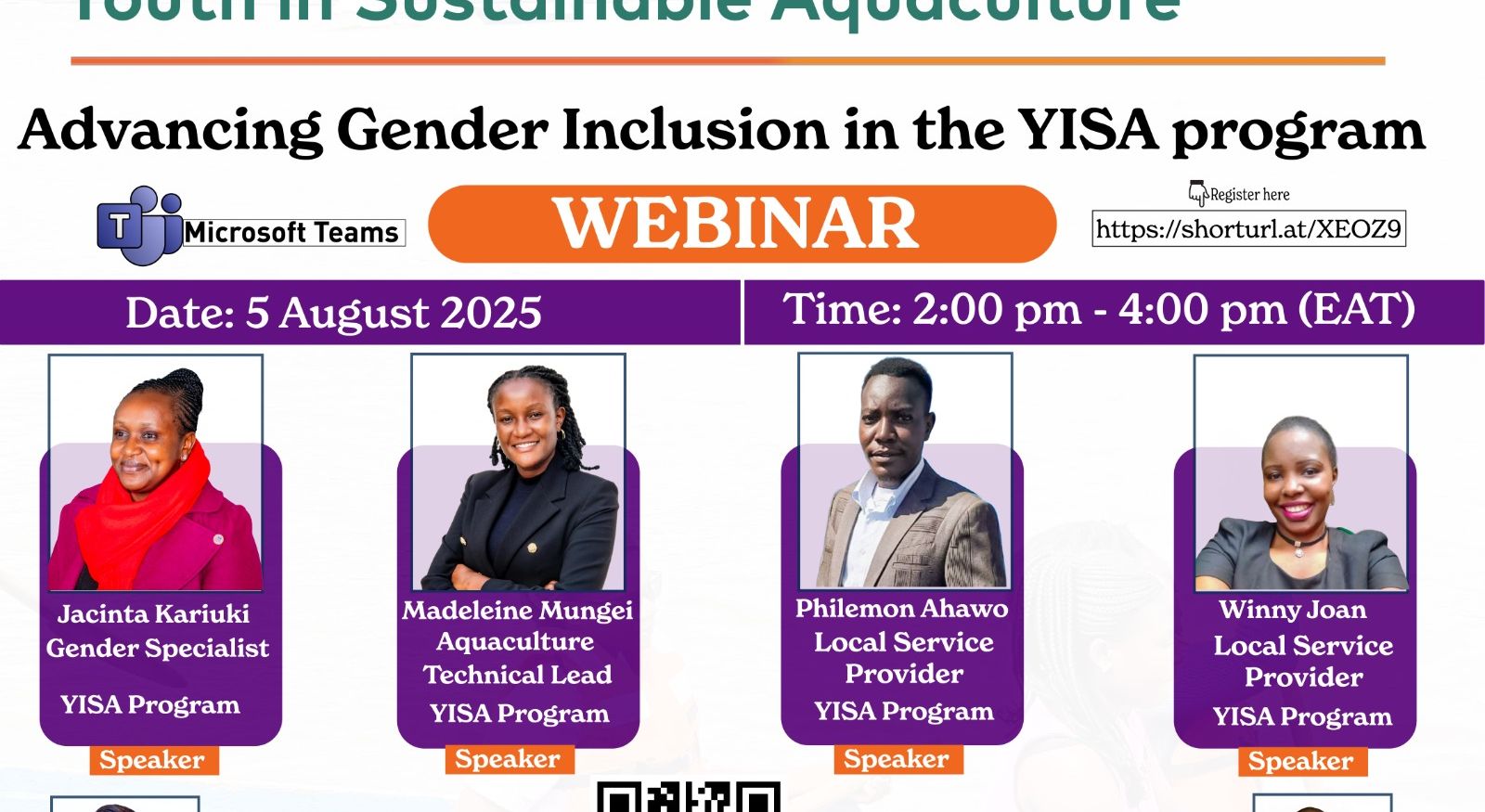
Advancing Gender Inclusion in Aquaculture: A Collective Responsibility for Thriving Communities
On August 5, 2025, the Youth in Sustainable Aquaculture (YISA) program brought together partners, participants, and stakeholders for a thought-provoking webinar focused on advancing gender equality and social inclusion within Kenya’s aquaculture sector.
With a goal of creating 150,000 dignified and meaningful jobs for young women and men including, persons with disabilities (PWDs), and internally displaced persons (IDPs) the conversation centered around how intentional design, and collective ownership can enable transformation at scale.
The session offered an opportunity to reflect on progress and reaffirm a shared commitment to inclusion that goes beyond participation. It invited the audience to rethink structures, systems, and strategies that often limit the potential of women and other marginalized groups in male-dominated value chains like aquaculture.
“As we incorporate the GALS methodology, we’ve developed a GESI strategy in aquaculture, in its final stages. The aim is to implement it collaboratively, incorporating the young women-centric design that gives them agency over interventions developed,” notes Jacinta Kariuki, Gender Specialist, YISA Program
Jacinta underscored how the Gender Action Learning System (GALS) methodology has informed the development of a Gender Equality and Social Inclusion (GESI) strategy now in its final stages.
The GESI strategy draws on participatory tools such as the Vision Journey, Family Tree, and the Social Empowerment Tool to help participants unpack household dynamics, power relations, and long-term personal and economic goals. By equipping participants with these tools, the program seeks to not only advance awareness but enable behavioral shifts that foster equitable outcomes.
According to Madeleine Mungei, the YISA program Aquaculture Technical Lead, the program has integrated the GESI strategy using various approaches that ensures that the program caters for the needs of all program participants especially during the trainings
“To further integrate GESI within our aquaculture training, we have made our training times more accommodative between 10:00 a.m. and 1:00 p.m., set up gender desks at various Beach Management Units (BMUs) within the YISA program implementing counties, and we are collaborating with the Light for the World to ensure our trainings are intentional and inclusive of persons with disability, “adds Madeline.
She highlighted key adaptations that have helped integrate GESI principles into technical training. Such deliberate design choices speak to the program’s commitment to reach the most underserved. Inclusion is not left to chance. It is embedded in both planning and implementation.
Philemon Ahawo, a local service provider in the YISA program rallied men to be allies not bystanders in integrating the GESI within the communities noting that gender equality cannot be the work of women alone but should be a shared responsibility if the benefits of the program are to be sustained across entire communities.
“As we work within the program, let’s remember, it’s not a competition between men and women but rather a collaboration. When we work together, include men more, we thrive together,” says Philemon.
Inclusion is not just a goal it is the path, emphasized Philemon.
The webinar provided an opportunity for the YISA program stakeholder to understand the transformative power of inclusion when it is embedded with intentionality and dignity. The YISA program continues to show that when young women, PWDs, and young men from all walks of life are given the tools, the space, and the support to lead, they do. And when we do it together, we don’t just change lives we reshape entire systems.
Data points
To date, 73% (34,011) of YISA participants across the six implementing counties are women, with 2.7% (1,247) representing PWDs and 0.2% (105) being internally displaced youth, demonstrating progress in reaching underrepresented groups.
About the YISA Program
The Youth in Sustainable Aquaculture (YISA) program is a partnership program between by the Mastercard Foundation and i a consortium of partners led by Farm Africa, Echo Network Africa Foundation (ENAF), Lattice, Aquarech Ltd, Ramogi Institute of Advanced Technology (RIAT), Hydro Victoria, and Livingwood Consultants Ltd. The program aims to unlock meaningful employment for young women and men incuding the PWDs and IDPs across Kisumu, Homa Bay, Siaya, Kakamega, Busia, and Kilifi counties, with gender equality and social inclusion at the center of its design.
Other posts
Browse Other Blogs
We have more on our hub for aquaculture innovation, field insights, success stories, and sustainability news across East Africa.

Aquaculture’s Role in Food Security
How can aquaculture address global food security challenges? Here's the vital role aquaculture plays in feeding the growing population.

Crafting Compelling Presentations Today
Create presentations that captivate, persuade, and impress professional audiences.

Unlocking SME Growth Strategies
How can aquaculture address global food security challenges? Here's the vital role aquaculture plays in feeding the growing population.