Working through market partners to strengthen youth participation, income, and pathways to dignified work
How do you help young people earn a real living from the soy and fish value chains, in a way that lasts beyond the programme? Lattice works through existing local businesses as Market Partners, linking skills and training to actual buyers and market demand. A short brief on our market systems approach, and how we measure what really matters: not just who was trained, but who is earning.

Mika Mitoko
27 October 2026
Purpose of this brief
This brief explains how Lattice applies a market systems development (MSD) approach in the soy and fish value chains. It summarizes the roles of Market Partners and the wider ecosystem, including cooperatives, associations, apex and participant networks, community structures, and public institutions, the way services and commercial relationships connect, Lattice's facilitation role, and how progress is measured.
Approach at a glance
Lattice works through existing market actors rather than delivering isolated interventions directly. These actors, typically local SMEs embedded in the target value chains, are engaged as Market Partners because they already have business operations, commercial incentives, and access to networks of young people and farmers.
Market Partners operate within a wider ecosystem. Government and public institutions, apex networks, youth and women's networks, community-based organizations, producer associations, and cooperatives help mobilize and represent participants, coordinate services, strengthen accountability and safeguarding, and address constraints that individual firms cannot resolve alone.
Market Partners can perform two complementary but distinct functions:
- Skills development and capacity building. As Local Service Providers (LSPs), partners deliver technical training, Business Development Services (BDS), coaching, mentorship, productive support, exposure visits, and related services that strengthen young people's ability to participate productively in the value chain.
- Market access and commercial integration. As commercial market actors, partners provide offtake and other market linkages, including purchasing products from participating youth and farmers. This connects skills and production to market demand and income generation.
A partner may provide services, act as a buyer or other commercial actor, or perform both functions. The broader objective is to make these relationships commercially viable so that services and market opportunities can continue beyond direct programme support.
How the market system works
The approach links the core value-chain transaction with supporting services, representative and community structures, public-sector coordination, commercial relationships, accountability, and measurement needed to improve inclusive youth economic participation.
MSD value-chain frame
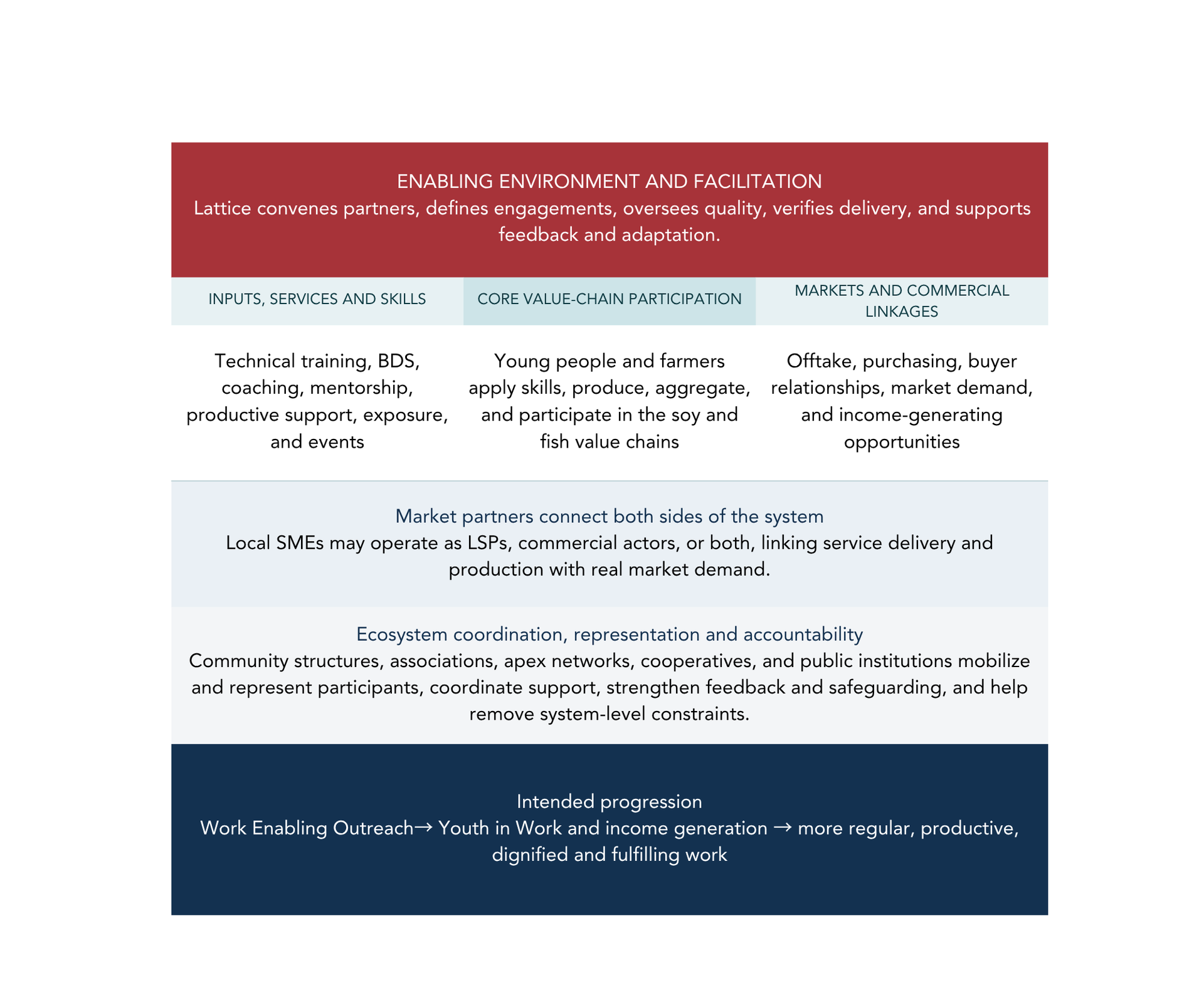
How to read the model
Left to centre: services and capacity building enable young people to participate more productively in the value chain.
Centre to right: production is connected to buyers, offtake, and other commercial mechanisms that can translate participation into income.
Across the system: Market Partners bridge services and markets; cooperatives and associations aggregate voice, demand, and production; community and apex structures strengthen reach and representation; government enables coordination and alignment; and Lattice facilitates, verifies, and supports adaptation.
Roles and accountabilities
Actor
Role in the system
Market Partners (LSPs/SMEs)
Deliver services and/or act as commercial market actors, linking participants to capabilities, productive opportunities, and markets.
Cooperatives and producer associations
Aggregate production and demand, organize shared services, strengthen bargaining power, set or reinforce member standards, and connect members to buyers, finance, inputs, and information.
Apex, youth, and women's networks
Represent member interests at scale, amplify participant voice, identify cross-cutting barriers, support peer learning, coordinate referrals, and help services respond to the realities of young people and women.
Community structures and CBOs
Provide local trust and reach, mobilize and refer participants, identify vulnerable groups, sustain feedback loops, support safeguarding, and reinforce community-level accountability.
Government and public institutions
Convene and coordinate ecosystem actors, align interventions with policy and public services, support extension, standards, safeguarding and referrals, and help address infrastructure, regulatory, and other system-level constraints.
Lattice
Acts as market facilitator; establishes partnerships, defines the scope of engagement, oversees delivery, and verifies results without replacing the market actors.
Field staff
Monitor implementation and verify that agreed activities, standards, and timelines are met.
Community facilitators
Serve as the first point of contact with participating youth groups and support coordination, accountability, and feedback.
Young people
Participate in the value chains, use the services and opportunities available, generate income, and progress towards more dignified and fulfilling work.
Measurement and learning
The monitoring framework distinguishes between the support made available and the economic changes that follow.
Outputs — Work Enabling Outreach (WEO). Lattice verifies interventions that enable access to economic opportunities, including training, productive inputs, BDS, coaching, mentorship, exposure visits, and relevant events. The focus is whether activities occurred and participants received the intended support.
Outcomes — income generation. Lattice assesses whether young people earn income from participation in the value chain, how regularly they earn, and whether their economic participation is improving. The emphasis therefore extends beyond the number trained or reached.
Longer-term ambition — dignified and fulfilling work. Initial participation and income generation should create a foundation for more consistent, productive, and rewarding economic engagement.
Key distinction: WEO measures the support and opportunities made available; income generation and progression towards dignified and fulfilling work indicate whether those interventions are producing meaningful development outcomes.
What makes the approach systemic
- It works through existing local market actors and their commercial incentives.
- It connects capability building to actual value-chain transactions and demand.
- It engages cooperatives, associations, apex networks, community structures, and public institutions to improve representation, aggregation, coordination, inclusion, safeguarding, and accountability.
- It strengthens relationships among participants, service providers, buyers, and facilitators.
- It uses verification and feedback to improve implementation and accountability.
- It aims for services and market opportunities to continue beyond direct programme support.
Other posts
Browse Other Blogs
We have more on our hub for aquaculture innovation, field insights, success stories, and sustainability news across East Africa.